
Cleared by your PT. Not ready for sport.
Most people are "cleared" medically long before they're actually prepared physically. AthleX bridges the gap from physical therapy to strength, power, and sport readiness using a structured, data-informed approach. This isn't generic personal training. It's a rehab-to-performance system.
No pressure. We'll tell you honestly if we're the right fit, even if that means pointing you somewhere else.
This program is for you if:
- You have a specific sport or competitive goal, not just daily life, to get back to
- You can move fine in daily life but can't sprint, jump, cut, or lift heavy yet
- You were told you're "cleared," but you don't trust your body under sport demands
- You're afraid of re-injuring the same area during play or competition
- You're returning to ACL/knee surgery, back or disc injuries, shoulder or ankle injuries, or running injuries
- You're returning to tennis, soccer, pickleball, basketball, golf, running, or recreational sports
No specific sport goal, just want everyday strength and confidence back? See Post-Rehab Training.
This isn't the right fit for everyone, and that's okay.
- You're looking for insurance-based care
- You want passive treatment only
- You want generic training with no individualization
- You're chasing quick fixes
- You're not willing to train consistently
- You're not ready to invest in long-term outcomes
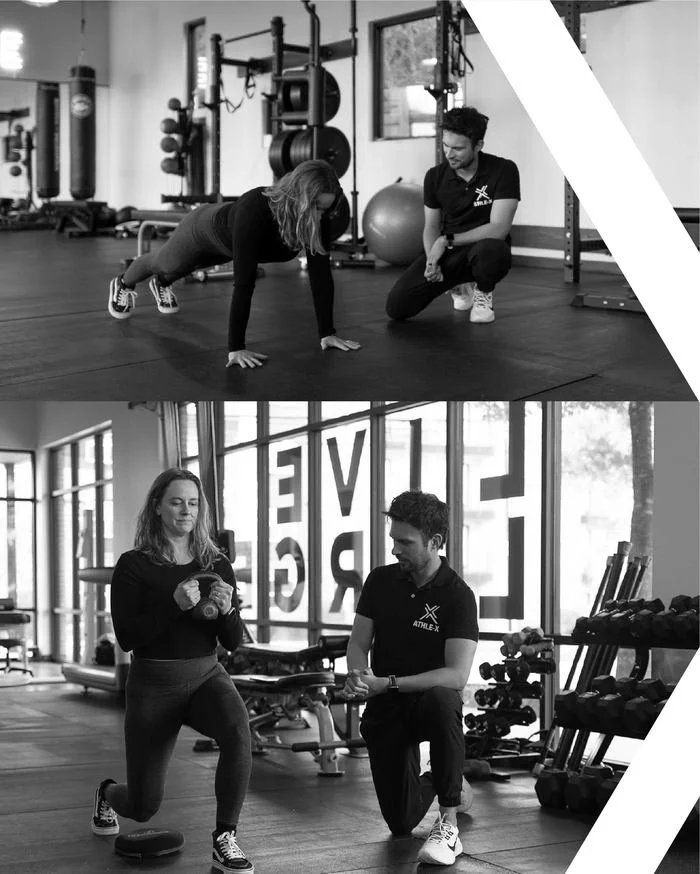
Medical clearance is not performance readiness
Physical therapy is essential, but it's not designed to take you all the way back to sport. Most PT programs end when you can walk without pain, climb stairs, do light bodyweight exercises, and regain basic range of motion. That's medical clearance. That's not performance readiness.
Sport requires:
- High force output
- Rapid deceleration and re-acceleration
- Power and elasticity
- Fatigue tolerance
- Asymmetry management
- Confidence under load
Skipping this middle phase is one of the biggest reasons people re-injure the same area, develop a new injury, plateau, or stay stuck in "careful mode" for years. AthleX exists specifically to fill this missing middle step.
We don't guess. We don't rush. We don't follow templates.
Assess
Joint-by-joint assessment, full movement screen, strength testing, force plate analysis for asymmetries and power, Moxy monitoring, and InBody body composition. This tells us what's actually weak, what's compensating, and what needs to be built before sport-specific work begins.
Plan
Your program is built around your injury history, sport demands, current strength levels, movement limitations, and psychological readiness: low-load control → moderate strength → high-load strength → power and elasticity → sport-specific drills → real-world readiness.
Train
Progressive strength training, velocity-based lifting for intent and power, controlled plyometrics, deceleration and change-of-direction drills, and sport-specific movement patterns. Manual therapy is used as support, not the main solution.
Track
Strength benchmarks, force plate symmetry improvements, power output, tissue oxygen response, movement quality, and confidence under load, so we can progress you intelligently and reduce reinjury risk.
Most places fall into one of two extremes
Traditional physical therapy, or generic personal training. AthleX sits in the middle on purpose.
- We specialize in the post-rehab phase
- We use objective testing, not guesswork
- We progress load intentionally, not emotionally
- We train real strength, not just rehab exercises
- We build muscle mass for long-term resilience
- We prepare you for high-demand movement, not just daily activity
- We treat manual therapy as a tool, not a crutch
This is not about doing "more rehab." It's about doing the right kind of training at the right time.
The patterns that keep people stuck or injured
Mistake #1 — Going back too soon
Feeling better is not the same as being ready. Pain reduction happens faster than strength restoration. Most people return to sport with massive capacity gaps.
Mistake #2 — Only doing light rehab exercises
Bands, balance drills, and bodyweight work aren't enough to prepare tissue for sport forces. You need progressive overload.
Mistake #3 — Avoiding heavy loading out of fear
Avoidance makes tissue weaker, not safer. Properly dosed strength training is protective, not dangerous.
Mistake #4 — Training like nothing ever happened
Going straight back to bootcamps, classes, or high-volume workouts ignores your injury history. That's not resilience. That's roulette.
If your sport demands strength, speed, or impact tolerance, this system applies.
- Running
- Tennis
- Pickleball
- Basketball
- Soccer
- Golf
- Weightlifting
- Recreational league sports
- Outdoor endurance events
Our clients don't just "feel better"
This is not about chasing pain-free days. It's about building a body that can handle real-world demands.
- Regain strength symmetry
- Increase power output
- Improve movement quality
- Build lean mass
- Reduce flare-ups
- Return to sport with confidence, and train without fear again
Results shown are individual and not guaranteed. Outcomes vary by starting point, condition, and consistency.
Real athletes, real return-to-sport outcomes
"Highly recommend training with Chris from AthleX. I have seen great progress since signing on for a 12 week program and have already broken through barriers with my repaired torn ACL that I was unable to while seeing a traditional physical therapist weekly for the last two years."
"After a full body assessment, Chris and his team put together a plan not just to get me back to where I was pre-injury, but even more explosive, more flexible, more balanced, and more consistent than before. I've worked with strength coaches in college — Chris stands head and shoulders above."
More Reviews From Google
Results shown are individual and not guaranteed. Outcomes vary by starting point, condition, and consistency.
It starts with a 90-minute evaluation
Your evaluation includes:
- Joint-by-joint assessment and movement analysis
- Strength testing
- Force plate testing
- Moxy tissue oxygen monitoring
- InBody body composition
- A personalized return-to-sport roadmap
This session tells us exactly where you're at now, what's holding you back, what needs to be built, and how long your progression should realistically take.
Before you book
I was cleared by my physical therapist, so why don't I feel ready for sport?
Medical clearance and sport readiness are different things. Physical therapy typically ends once you can walk without pain, climb stairs, and regain basic range of motion. Sport demands high force output, rapid deceleration, power, and confidence under load, which is a separate phase of training most PT programs are not designed to finish.
What does the return-to-sport evaluation at AthleX include?
The 90-minute evaluation includes a joint-by-joint assessment, movement analysis, strength testing, force plate testing, Moxy tissue oxygen monitoring, and InBody body composition, resulting in a personalized return-to-sport roadmap.
Return to Sport Training in Austin, TX Starts Here
Book your free discovery call and build a plan that actually prepares you for real training and sport again. Looking for Chronic Pain, Strength & Performance, or Post-Rehab Training?
No pressure. We'll tell you honestly if we're the right fit, even if that means pointing you somewhere else.